Oedipus & Antigone Book Review
By Omar Andre
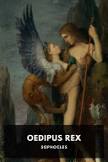
Sophecles has not only made a great story once, but he also managed to follow it up in a cohesive way that follows the same themes, and says something new, and I think that’s amazing. Oedipus rex follows the story of the ruler–Oedipus–of a city–Thebes– in his quest to find out who killed the past ruler so that the gods stop the curse they had put in his city. Antigone, which happens after the events of Oedipus Rex, follows Antigone, Oedipus’ daughter, trying to have a proper burial for one of her brothers, which was very disliked by the new ruler and had ordered him to not be buried properly. Both of these stories explore a tragedy through a different lens, both have you ask the question: “did they deserve this?” and I think both give different answers that are worth thinking about.
Because it is a play, it is written in a very dramatic way, with lots of monologues, which makes the characters reveal a lot of their thinking and philosophy pretty explicitly. I think this is a good thing, and utilized especially well in Antigone, where the main antagonist and ruler, Creon, spends a good amount of time monologuing about his thinking.
I’m not going to talk about Oedipus Rex because it is very easy to spoil something, it has a conflict questioning something very early on and I don’t wanna reveal who’s right, so it does have some aspects of the mystery genre, though I will say that Oedipus Rex is generally a likable character with actions that mostly make sense, except for one that I don’t think fits his character. Antigone(The play) is a little more predictable, though not less interesting. In Antigone, the main character, also Antigone, is characterized by having the strongest will to follow the rules of the gods, and the main antagonist, Creon, is characterized by his belief that everyone must follow authority, no matter if they are “wrong” or not. This main conflict is these two characters fighting for which “rules” to follow.
In both stories, most main characters are archetypes, they have a couple of core beliefs that characterize them and impact the story the most, with Antigone, it’s her belief in the gods’ rules, in Creon, the absolute belief in Authority. This is where the monologues shine, because characters have a chance to apply their core beliefs into everything that is happening in the story, and reason why they think their beliefs are correct. This makes the story interesting because it’s the author telling us which character they think is right, and pretty explicitly. It is also explicit in telling us which characters are likable and which aren’t, which is the main reason, in my opinion, why the story is more predictable than Oedipus Rex, the “wrong” guy is characterized as “bad” from the first scenes.
The plays are both tragedies, featuring various archetypes with clear and explicit beliefs being struck by tragedy, and the point of both is to get you to ask yourself: “how did these people’s beliefs lead to this”. Because of this simplicity of characters, I think this story could be enjoyed by everyone, but if you are a fan of tragedies or theater, I think you will enjoy this reading even more, it has some dramatized dialogue and lots of monologues that fans of theater might enjoy, and, of course, it’s a classic tragedy story that fans of tragedies would like. With Oedipus Rex specifically, I would also say that it is, if not a mystery, it is at least a tragedy with some aspects of a mystery. Because of this, I would say that fans of mystery specifically would enjoy Oedipus Rex.
I really enjoyed both of these plays, I enjoyed Oedipus Rex’s mystery elements, I enjoyed the characters and the conclusion, though I thought that there was a bit of filler in the middle, it felt like Oedipus was kinda just running around. I felt that Antigone was fantastic, it had mostly the same themes as Oedipus Rex, but it handled them in a different way. Antigone was not a mystery, it was pretty clear who the “good” guys and “bad” guys were in the eyes of the author, but the way that the characters were explored through monologues detailing their worldview was engaging and made the predictable plot interesting to think about. I also enjoyed Antigone’s ending, because it leaves the aspect that maybe Creon was right in a way too. I also enjoyed the tragic aspect in both of them, they both criticize the gods and fate’s cruelty. I won’t talk about Oedipus because it is a mystery, but in Antigone, some innocents were punished for no real reason, even the ones who were totally in the right, and there are references to a curse in Antigone’s family.
Because of all of this, Oedipus Rex gets a:

And Antigone gets a: